
Become the Kybernetes of Your AI
Think AI is just for 'prompters'? Think again! Join the crew who truly navigate the waters of artificial intelligence. Discover why being the 'Kybernetes' of your AI is key to mastering productivity, planning and directing like a true digital high-seas captain.
The Importance of Direction
Beyond the “Prompt” The problem with most AI users today is that they act as passengers, not pilots. They believe success lies in a perfect “magical prompt formula.”
The Core Point
AI is not a magic wand; it’s a productivity tool that amplifies its user’s judgment. If you don’t know what you want or what a good outcome looks like, AI won’t either.
Why I Talk About “Kybernetes”
This takes me back to my university days, studying systems theory (which, believe it or not, had little to do with computer science; it was a subject shared with business and economics students).
**What is the ‘Kybernetes’? **
To understand your role, let’s go back to the root.
The Term: The Greek word kybernētēs means “pilot,” “helmsman,” or “governor.”
The Evolution: From this term derives the Latin word gubernator, and later, in the 20th century, “cybernetics,” defined by Norbert Wiener as the study of control and communication in the animal and the machine.
What Should Be Your Role?
When you use AI, you must be the Kybernetes. Your job is to direct, not just request.
The Three Pillars of Productivity
Productivity with AI is not limited to the input phase (the prompt) but extends to the planning and execution phases.
Pillar 1: Knowledge and Foundation (Your Treasure Map) Prior knowledge is vital.
- Informed Judgment: To ask AI to draft a crucial email, you must know if the tone it provides is appropriate for your industry. If you request a financial analysis, you must understand the terms and metrics it uses.
- The Quality Filter: The Kybernetes is the ultimate quality filter. Without your expertise, a seemingly fluent AI output can be a costly mistake.
Pillar 2: Planning and Decision-Making (The Route) Before typing the first word, you must have a strategic plan, just as you plan billing and communication with international clients.
- Output Structure: Define the goal, structure, and key points before making the request. For example, if you need a report, don’t ask “make me a report.” Instead, ask: “Generate section 3 of a report for the CEO that should be analytical, based on these 5 figures.”
- The Fork in the Road: AI will offer you multiple paths (multiple drafts, styles, or approaches). Your job is to choose which path to follow (the decision), not just to read what is presented to you.
Pillar** 3**: The Prompt as a Tactical Tool (The Rudder)
The prompt shifts from being the primary task to merely the execution of your strategy.
- Command, Not Request: Use the prompt to direct the process you have already planned, not for the AI to plan it for you. Use role-playing and constraints to ensure the approach you have previously chosen.
Example: Instead of: “Write about Six Sigma.” Use: “Act as an academic journal editor. Your task is to review and strengthen the introduction of this text, ensuring all requirements are clear and concise in less than 10 lines.”
Process Flow
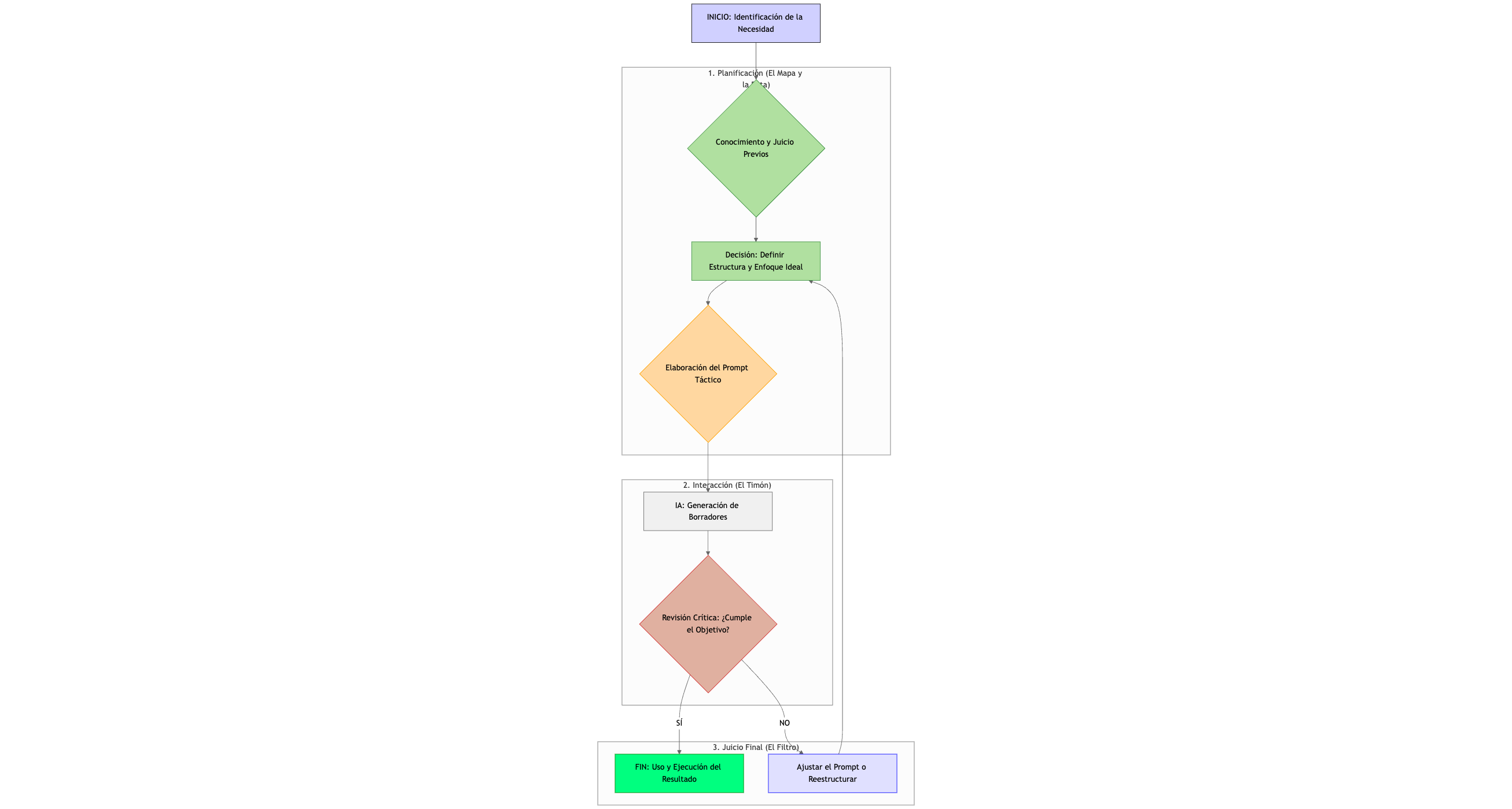
From User to Commander
The true value of AI in productivity is not the automation of the task, but the automation of execution.
The End Result: The “captains” of AI will be those who manage to produce 10x better results, not just 10x faster, because their judgment and strategic planning guide every interaction.
You cannot let AI try to think for you; you can leverage it for the discovery process, but do not assume it will take care of everything. Plan, make decisions, and then, and only then, use the prompt to execute your vision.